
Lately I have been thinking a lot about Product Marketing inside companies and about the role of the person doing Product Marketing. Of course my perception is based on my own reality, on what I see around me and what I read on the subject. You may see it differently. But let me share what I have been noticing.
Like Product Management, Product Marketing is usually represented as a Venn diagram, with the function in the center and bigger areas of the company around it:
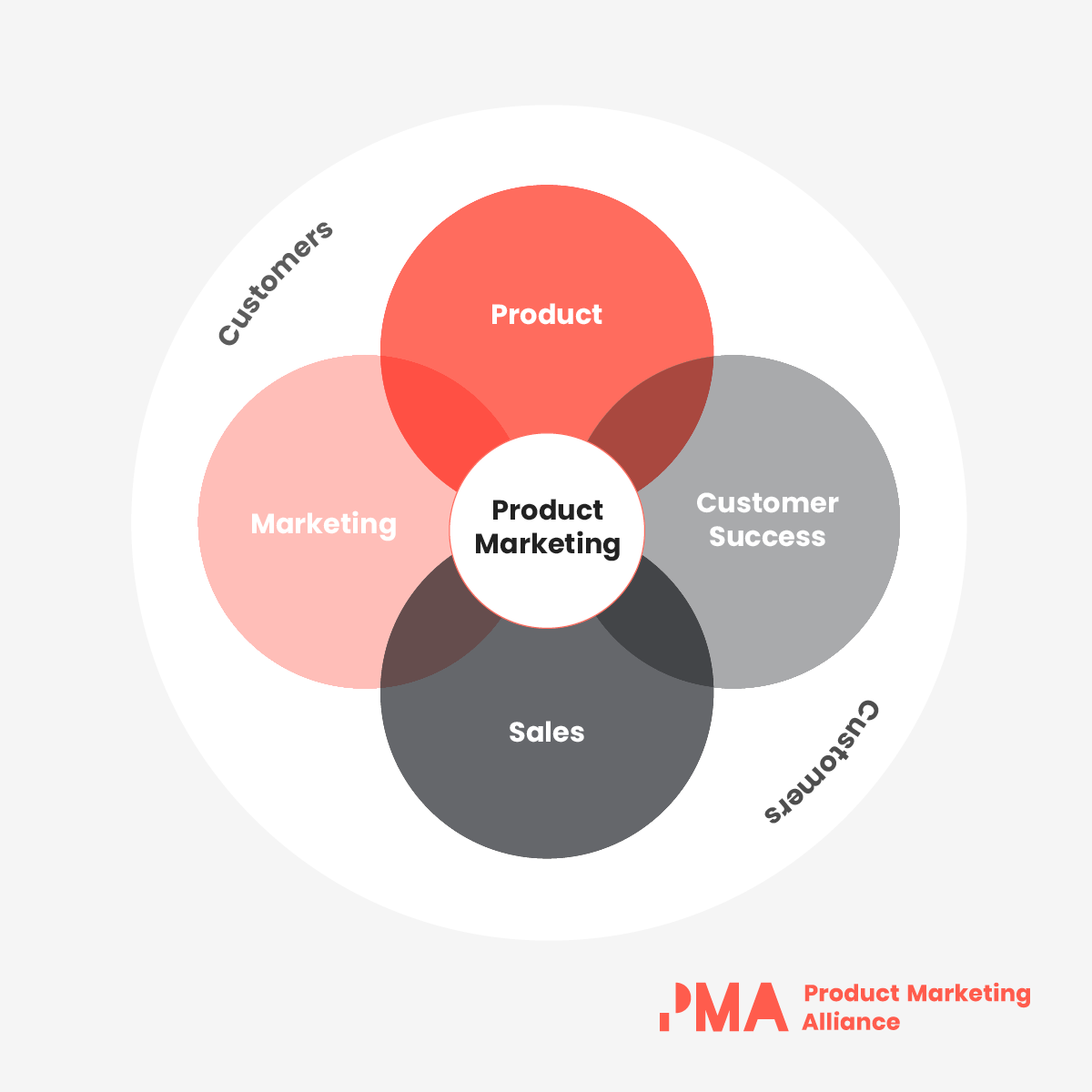
I have used this diagram many times, and when explaining what Product Marketing is I have also repeated this sentence:
Product Marketing is the function that sits in the middle of Sales, Marketing, Product and Customer Success.
And I used to add:
It’s the function that aligns everyone on the company’s message and positioning. It is the guardian of that information.
I would say that if we asked anyone working in the field, something similar to these two ideas would come up when talking about Product Marketing in companies.
But I am starting to think this view of Product Marketing isn’t working in the discipline’s favor.
Let me explain why, by drawing a parallel with a pain that always shows up in surveys of Product Managers.
I recently saw that the activity PMs believe takes up most of their day is stakeholder alignment.
It seems natural. After all, Product is usually illustrated with this diagram:

If your function is seen as the one in the middle of other functions, it is fairly obvious that you will spend much of your time making sure people in those other areas understand, listen to and are aligned with your decisions.
Product Marketing is no different.
A while ago I tweeted a provocation:
Vocês sentem que áreas mais generalistas em empresas (aquelas que dependem muito de outras áreas) tem menos autonomia do que áreas especialistas (aquelas que na maior parte do tempo dependem apenas de si)?
— Felipe Barbosa (@felipecb_) January 19, 2022
(In English: “Do you feel that more generalist functions in companies, the ones that depend heavily on other areas, have less autonomy than specialist functions, the ones that mostly depend only on themselves?”)
If you think about it, we in Product Marketing are specialists in the discipline of Product Marketing. But it can be broad, and specializing would take us down to things like “competitive analysis specialist” or “go-to-market specialist”. In general, though, our day-to-day involves several business disciplines, which makes us more generalist than other functions.
That means this view of being the glue, sitting between Marketing, Sales, Product and Customer Success, often puts us in a situation where, while those other teams make decisions and get on with their work, we are there pulling in every direction and trying to reach an alignment that isn’t always real.
So we have to stay constantly focused on stakeholder alignment, spending a lot of energy on it instead of putting all our energy into solving the problems we were hired to solve.
What if, instead of Product Marketing being the glue that connects the ends, it were the force the other areas are pulled toward? The dynamic changes.
Think about it: if Product Marketing is the one that has to understand market dynamics (customers, competitors, macro and microeconomics) and its own product, and then, based on the company’s goals, work out and define positioning and messaging and Go-to-Market strategies (or just launches), then we shouldn’t have to make an effort to align other areas around it. It should be understood that other areas need to seek out that information. After all, everyone is going to the same place… right?
I think that would make for a healthier conversation.
I’m not saying internal communication wouldn’t happen or that there would be no collaboration between areas.
What I’m saying is that, to me, it should be organic. And for that to happen, I also understand it takes education.
That is the big point for me, and what I keep coming back to when I think about our role and our function.
The education about how we connect areas and create alignment seems to put more weight on a project management layer than on executing Product Marketing strategy.
Doing that for campaigns that are going to run is one thing. It’s natural, and the bigger the company, the more that coordination is needed.
But it seems to be seen as the default for the function.
The default is:
We are the ones who will always be the first to care about creating that alignment.
But we created that image ourselves. Back to the diagram I showed for Product Marketing.
At least that one puts Product Marketing in the diagram with some prominence, not just as a little sliver in the middle of the others.
And I’m not saying the work and the professionals aren’t seen as important. I think they are, and it’s no accident that more and more companies are looking for Product Marketing Managers.
What I want to raise is whether the way we do our work, and the way companies set up their teams’ dynamics, is the best way for Product Marketing people to deliver their best and focus on what they’re good at.
Maybe we should talk more about our function and our role in companies, and whether we are really working in the smartest way as Product Marketing people.
What do you think?